
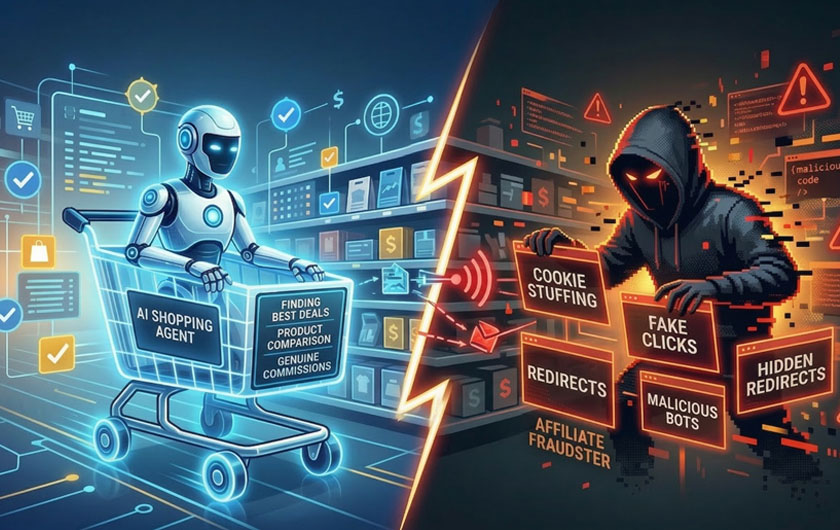
In recent years, browser extensions have become one of the fastest-growing surfaces for affiliate attribution manipulation. Coupon discovery tools, shopping assistants, and deal finding extensions now reach millions of users through browser marketplaces. While many operate legitimately, investigations across the affiliate industry have repeatedly shown that some extensions trigger affiliate redirects or overwrite attribution at the final stage of a purchase. Because these actions occur seconds before checkout completion, they can be extremely difficult for brands and affiliate programs to detect through traditional monitoring methods.
Over the past year, one of the most talked-about ideas in e-commerce has been AI shopping agents.
The vision sounded simple, instead of visiting multiple websites, a user could ask an AI assistant to find a product and complete the purchase instantly. The AI would search the web, compare options, and finish the checkout without the user ever leaving the chat interface. If that model had fully taken off, it could have quietly disrupted a large part of the affiliate marketing ecosystem. But recent developments suggest that direct checkout inside AI chat interfaces is being pulled back, at least for now. Instead of completing the transaction within the AI platform, users are once again being redirected to merchant websites to finish the purchase.
At first glance, this might look like a minor product decision. From an affiliate fraud perspective, it is anything but.
Why This Matters
When AI agents were expected to complete transactions directly, the purchase flow would have looked like this:
User → AI Agent → Checkout
- No browser session.
- No merchant website visit.
- No traditional checkout page.
For many forms of affiliate fraud, that would have required a shift in tactics. A large portion of attribution manipulation happens inside the browser, often at the final stage of the purchase journey. Browser extensions, injected scripts, and adware typically wait until a shopper lands on a retailer’s website before interfering with the transaction. If checkout never happened in the browser, those mechanisms would lose their opportunity. But with the rollback of AI-native checkout, the flow still looks familiar:
User → AI Recommendation → Retailer Website → Checkout Page
And that checkout page remains one of the most vulnerable points in the entire affiliate ecosystem.
The Role of Adware Extensions
Many browser extensions designed around coupon discovery or deal alerts quietly operate in the background while users browse the web. Their real activity often begins when a shopper reaches a merchant website.
At that moment, some extensions trigger actions such as:
- Inserting affiliate parameters into URLs
- Triggering hidden affiliate clicks
- Replacing existing affiliate cookies
- Redirecting traffic through affiliate networks
Because these actions happen just before the transaction completes, they can capture attribution for purchases that were never influenced by the extension. This behavior is commonly referred to as cookie stuffing or last-click attribution hijacking. The key point is that these tactics rely on one condition: the user must still reach the merchant website.
AI Discovery, Traditional Checkout
The emerging reality appears to be a hybrid model. AI tools will increasingly help users discover products, compare prices, and identify retailers. But the final step, the transaction itself, will still take place on the merchant’s website. That means the traditional browser-based purchase journey remains intact. And as long as that journey ends with a checkout page inside a web browser, the opportunity for browser-level attribution manipulation still exists.
What This Means for the Affiliate Ecosystem
AI may change how consumers discover products, but it hasn’t eliminated the technical environment where most affiliate fraud occurs. If anything, the new flow could create an unusual combination: AI-driven product discovery paired with browser-level attribution manipulation. Fraud actors rarely disappear when technology changes. They simply adjust to where the transaction still touches the open web.
For now, that touchpoint is still the checkout page. And as long as that remains true, the tactics built around browser extensions and last-moment attribution hijacking will continue to persist.
The Real Risk Still Lives at the Final Click
Much of the discussion around AI commerce focuses on how discovery is changing. AI assistants will increasingly recommend products, compare prices, and guide purchasing decisions.But the affiliate ecosystem is not defined by discovery alone. It is defined by attribution and attribution is still largely determined in the final moments before a transaction is completed.
As long as the purchase journey still passes through a browser session and a merchant checkout page, the technical environment that enables browser extensions, injected scripts, and redirect-based attribution manipulation will continue to exist.
In other words, AI may reshape how consumers find products, but the underlying mechanics that allow attribution hijacking have not yet disappeared. For fraud investigators and affiliate program managers, the lesson is straightforward: innovation at the top of the funnel does not automatically eliminate vulnerabilities at the bottom of it. Until the transaction itself moves entirely off the open web, the checkout page will remain one of the most critical points for monitoring attribution integrity and one of the most attractive targets for manipulation.
At Virus Positive Technologies (VPT), we don’t just observe these industry shifts we anticipate them. As AI discovery tools drive traffic back to the open web, the final click remains the most exploited link in the chain. Our mission is to ensure that your brand’s attribution remains untainted by bad actors.
The primary vector for modern stuffing involves 1x1 invisible pixels. When a user visits a compromised publisher site, the browser is instructed to load an image from an affiliate link. Even if the image never displays, the browser executes the URL request, dropping the cookie.